



# Adaptive Shape Grippers Market Insights
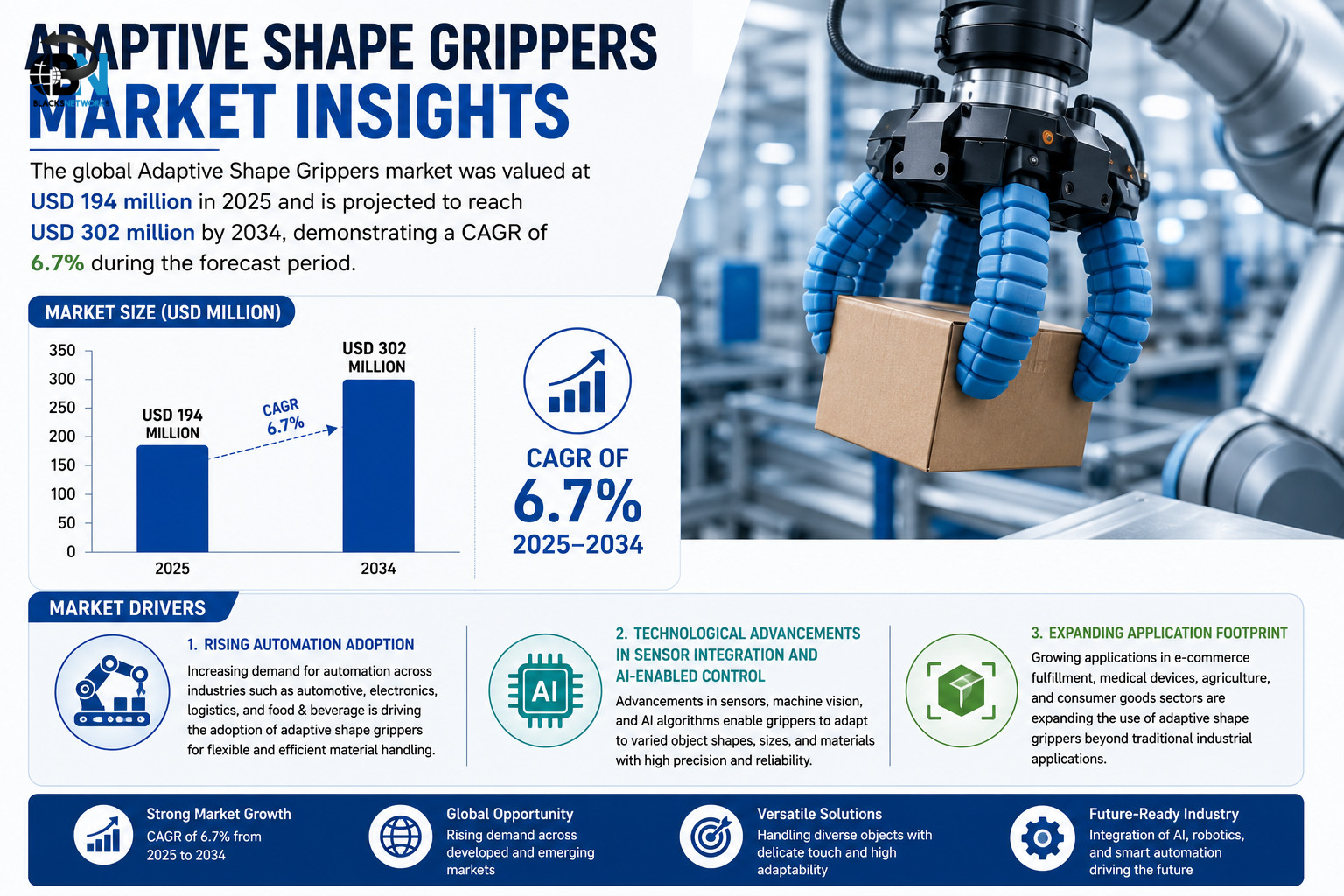
The global **Adaptive Shape Grippers market** was valued at **USD 194 million in 2025** and is projected to reach **USD 302 million by 2034**, registering a **CAGR of 6.7%** during the forecast period. Increasing demand for flexible automation solutions across manufacturing, logistics, healthcare, and electronics industries is driving market growth. As industries continue adopting smart manufacturing and Industry 4.0 technologies, adaptive robotic grippers are becoming essential for improving productivity, precision, and operational efficiency.
Adaptive shape grippers are intelligent robotic end-effectors that automatically adjust gripping force, position, and orientation based on the size, shape, and surface characteristics of an object. Unlike traditional fixed-jaw grippers, these advanced systems integrate force sensors, machine vision, and AI-driven control algorithms to securely handle irregular, delicate, and variable components while minimizing product damage and improving process flexibility.
The market is being driven by the rapid adoption of industrial automation across sectors such as automotive, electronics, food processing, and medical device manufacturing. Manufacturers are increasingly replacing manual handling and conventional gripping systems with adaptive solutions capable of handling multiple products without requiring frequent tooling changes. This helps reduce production downtime, improve first-pass yield, and lower operating costs.
Technological advancements in artificial intelligence, vision systems, tactile sensing, and real-time control software continue to expand the capabilities of adaptive shape grippers. Modern systems can accurately recognize and grasp components of different sizes and geometries while optimizing gripping force automatically. These innovations enable manufacturers to improve line efficiency, accelerate production, and support highly flexible manufacturing environments.
Beyond factory automation, adaptive shape grippers are gaining significant traction in logistics and warehousing, where they automate parcel sorting and material handling for items with varying shapes and dimensions. The growing e-commerce sector is creating additional opportunities as warehouses require intelligent robotic systems capable of managing diverse products. Medical device manufacturing also represents a key growth area, where precision handling of delicate instruments and components is essential.
Despite favorable growth prospects, the market faces several challenges. High initial investment costs for advanced robotic systems, sensors, and integration services can limit adoption among small and medium-sized enterprises. Integrating adaptive grippers into legacy manufacturing systems often requires customized engineering and controller upgrades, increasing implementation complexity. In addition, the shortage of skilled professionals capable of programming and maintaining AI-enabled robotic systems remains a challenge for many industrial users.
Emerging opportunities include cloud-based monitoring, predictive maintenance, digital twin technologies, and modular robotic designs that simplify equipment upgrades. These innovations enable remote diagnostics, improve equipment reliability, reduce maintenance costs, and support sustainable manufacturing by handling lightweight, recyclable, and customized products with greater efficiency.
By application, the market serves **Industrial Manufacturing, Logistics, Medical Device Manufacturing,** and other industrial sectors. Key end users include automotive manufacturers, electronics manufacturers, food and beverage companies, and various industrial users. Distribution is supported through manufacturing equipment suppliers, industrial solution providers, and technology integrators.
Regionally, **North America** remains a major market due to its advanced manufacturing infrastructure and early adoption of industrial robotics. **Europe**, led by Germany, continues to invest heavily in precision engineering and automation technologies, while **Asia-Pacific** is expected to record the fastest growth, supported by expanding manufacturing industries in China, India, South Korea, and other emerging economies.
Leading companies operating in the market include **Festo, Robotiq, OnRobot, Tesollo Inc., DH Robotics, WOMMER,** and **Effecto Group SpA**, all of which continue to strengthen their market positions through product innovation, strategic partnerships, AI-enabled technologies, and modular robotic solutions.
For detailed market forecasts, competitive analysis, regional insights, and strategic recommendations, visit the complete report:
**https://www.intelmarketresearc....h.com/machinery-and-










 1 (877) 773-1002