# Open Source Deep Learning Platform Market Insights
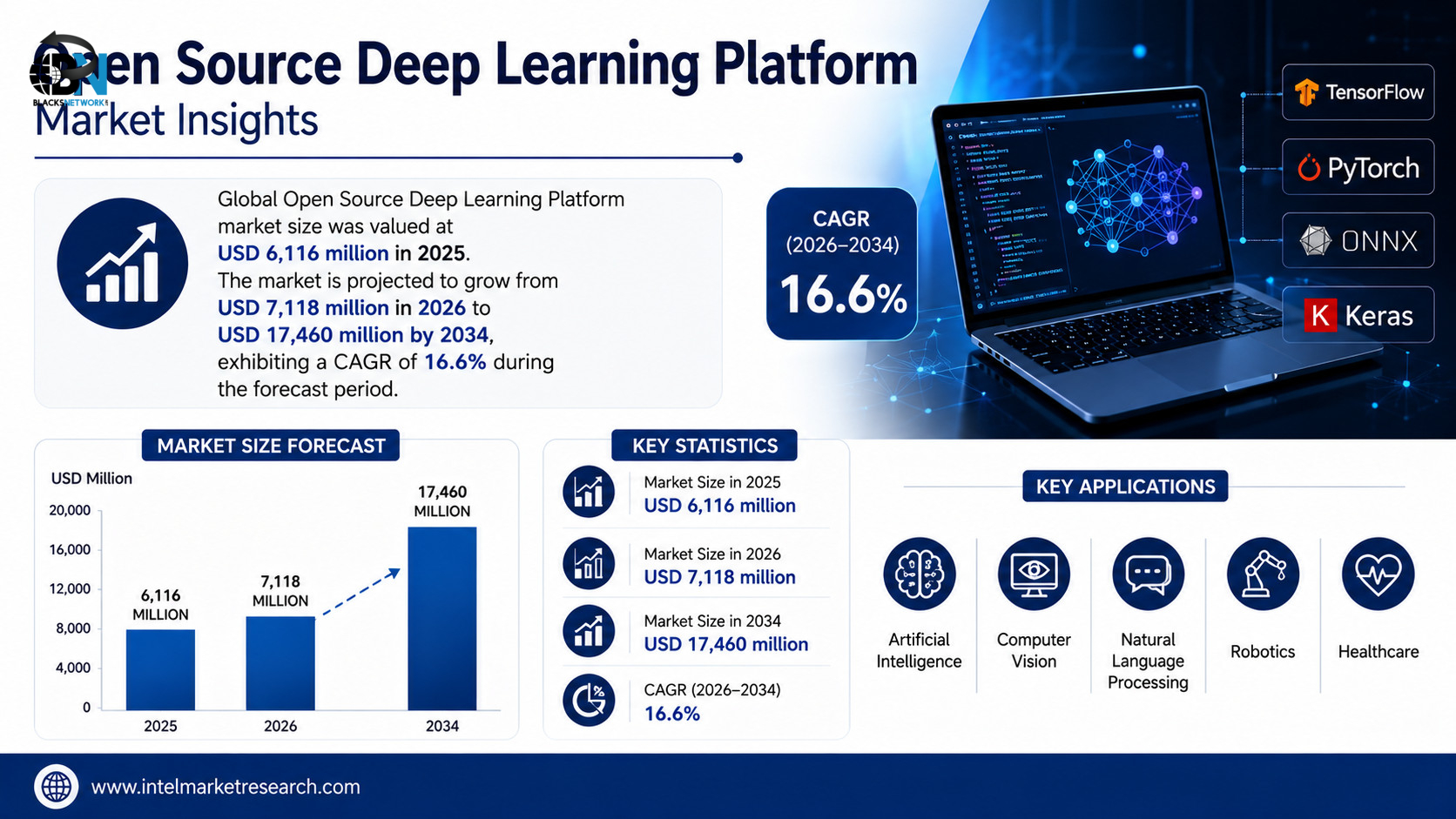
The global **Open Source Deep Learning Platform market** was valued at **USD 6.116 billion in 2025** and is projected to grow from **USD 7.118 billion in 2026** to **USD 17.460 billion by 2034**, registering a **CAGR of 16.6%** during the forecast period. Rapid adoption of artificial intelligence (AI), cloud computing, and machine learning technologies across industries is driving significant demand for open-source deep learning platforms worldwide.
Open-source deep learning platforms provide developers, researchers, and enterprises with freely available frameworks and tools to build, train, and deploy advanced neural network models without licensing costs. These platforms offer extensive libraries, scalable computing capabilities, and strong community support, enabling organizations to accelerate AI innovation while reducing development expenses. Widely adopted frameworks such as TensorFlow, PyTorch, ONNX Runtime, and Triton Inference Server continue to expand the global AI ecosystem.
The increasing adoption of AI across sectors including healthcare, finance, manufacturing, retail, automotive, and government remains the primary growth driver. Organizations are leveraging deep learning to improve automation, predictive analytics, computer vision, natural language processing, and decision-making. Open-source frameworks provide a flexible and vendor-neutral foundation that allows businesses to rapidly develop and deploy AI applications while avoiding the high costs associated with proprietary software.
Technological advancements and community-driven innovation continue to strengthen the market. Active developer communities regularly release new features, security updates, pre-trained models, and optimization tools that enable faster experimentation and shorter development cycles. Integration with cloud-native infrastructure, container orchestration platforms, and MLOps pipelines further simplifies AI deployment and supports enterprise-scale machine learning operations.
Growing demand for edge AI and Internet of Things (IoT) applications is creating additional opportunities. Lightweight deep learning frameworks with model compression, quantization, and hardware acceleration enable real-time inference on smart cameras, industrial equipment, autonomous vehicles, and connected devices. Governments, research institutions, and technology companies are also increasing investments in responsible AI, federated learning, and privacy-preserving machine learning, further expanding the market landscape.
Despite strong growth prospects, several challenges remain. Successfully deploying deep learning platforms requires specialized expertise in GPU computing, distributed training, and machine learning operations (MLOps), contributing to an ongoing shortage of skilled AI professionals. Integration with legacy enterprise systems can also increase implementation complexity and costs. Additionally, organizations must address cybersecurity risks, software vulnerabilities, and compliance with evolving data privacy regulations when adopting open-source technologies.
The market is segmented by application, end user, distribution channel, and region. Major application areas include **AI research and development, enterprise AI deployment, edge and embedded AI,** and **cloud-native AI services**. End users include large enterprises, small and medium-sized businesses, startups, academic institutions, and research laboratories. Deployment is supported through cloud service providers, on-premise infrastructure, container platforms, and third-party marketplaces.
Regionally, **North America** leads the market due to its advanced technology ecosystem, strong cloud infrastructure, and substantial investments in AI research. **Europe** continues to expand through collaborative research initiatives and digital transformation programs, while **Asia-Pacific** is expected to witness the fastest growth as governments, enterprises, and technology firms accelerate AI adoption and innovation.
Leading platforms shaping the market include **Google TensorFlow, Meta PyTorch, Microsoft ONNX Runtime, NVIDIA Triton Inference Server, Horovod, Apple Core ML, Baidu PaddlePaddle,** and **Intel nGraph**. These platforms continue to evolve through community collaboration, cloud integration, and continuous technological innovation.
For detailed market forecasts, competitive analysis, regional insights, and strategic recommendations, visit the complete report:
**https://www.intelmarketresearc....h.com/information-an















 1 (877) 773-1002